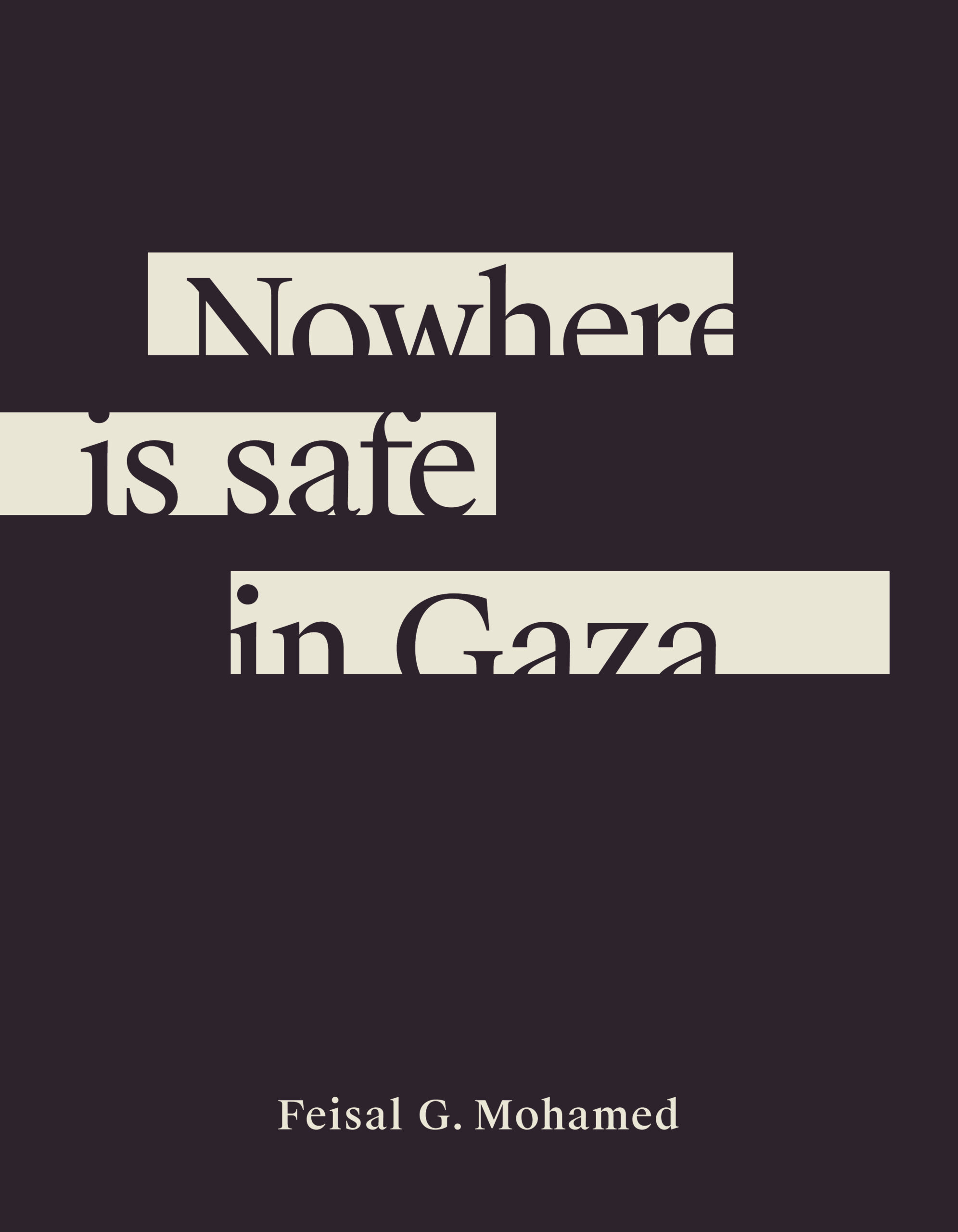
Nowhere is safe in Gaza by Feisal G. Mohamed
Price range: $13.99 through $24.95
A book-length erasure poem that takes as its source text South Africa’s application to the International Court of Justice charging Israel with violations of the Genocide Convention.
7 X 9 Inches | 200 pages
Publication Date: May 26, 2026
ISBN 9781771316736
Trade Paperback $24.95 | |
EPUB + PDF $13.99 |
In Nowhere is safe in Gaza, Feisal G. Mohamed distills and amplifies the human experience at the heart of this legal text, highlighting the plight of Palestinians on the ground and the openly stated intentions of Israeli officials. Through the use of erasure techniques, the language of bureaucracy fades into the background, allowing Palestinian voices to hit us with their full expressive force.
Praise for Nowhere is safe in Gaza
“While reading Feisal Mohamed’s Nowhere is safe in Gaza, I felt myself falling between the archipelagos of found verse and into the silent space of redaction where the catastrophe of genocide leaves chasms of loss. Excised sentences signal solidarity with those who refuse erasure, with those who resist statelessness. These pages map a territory scraped down to hospital, blood and bomb but still burgeoning with humanity. From that space, between bulldozed graveyard and blasted church, Mohamed exhumes for us a skeletal, excoriating body of testimony. Here is a gaunt witness to speak through and beyond the specter of 21st century censorship and into the power of poetry.”—Tyehimba Jess, author of Olio
“As the horrors in Gaza and the rest of Palestine have multiplied and continue, and as the world’s governments suppress the outcry of most of their citizenry while normalizing the genocidal actions of Israel and its allies—the US first and foremost—it is more than instructive to read Feisal G. Mohamed’s Nowhere is safe in Gaza. Mohamed’s text (even based only upon the first few months of the Israeli/US assault), is a fierce dirge descrying the mass grave of justice, the stopping of ears and the blinding of eyes, that characterize the world we now inhabit.”—Ammiel Alcalay, author of Controlled Demolition and Follow the Person
“Recuperating the Miltonic theme of blindness and insight, Feisal G. Mohamed entreats us to look past what he has erased deliberately from our sight. Nowhere is safe in Gaza does away with the legal structures that have failed to do the work of moral reckoning and through that darkness, the book makes visible—painfully, startlingly—the material destruction of Gaza and the needs of every human being on earth, not least Palestinians: to be seen and treated as human.”—Nyla Matuk, author of Leila and Khaled
Reviews of Nowhere is safe in Gaza
“Mohamed’s erasures, strategic repetitions and visual experiments cause the emotional impact of Israeli violence to accrue and intensify across the entirety of the book.”—melanie brannagan frederiksen, The Free Press
About the Author
Feisal G. Mohamed is a professor of English at Yale University with degrees in biology, English, and law. A past president of the Milton Society of America, his most recent books are Sovereignty (2020) and Resistance: A Paean to the Liberal Arts (forthcoming). In addition to academic venues, his writing has appeared in The New York Times, Dissent Magazine, the Chronicle Review, The Yale Review, The American Scholar, Huffington Post, Boston Review, and on the website of The New Republic. He grew up in Edmonton, Alberta and now lives in Connecticut with his family.