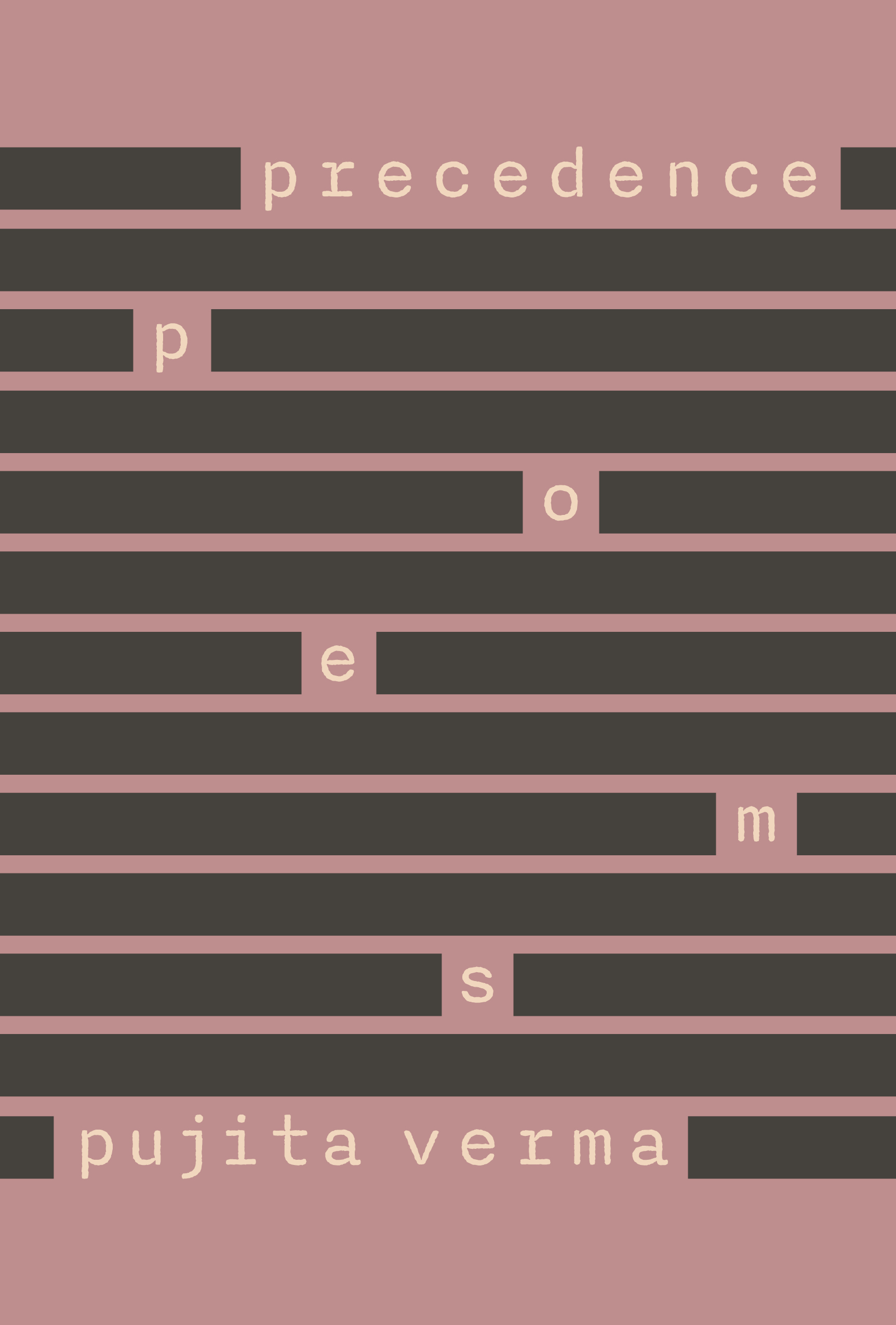
Grounded in a recent legal case that crosses borders, Precedence offers an intimate and stunningly poised insight into a young woman’s experience leaving home and facing her father in a Canadian courtroom. Pujita Verma’s tender, hopeful voice exposes the shortcomings of the international legal infrastructure in providing recourse to survivors of childhood sexual abuse, while honoring the generations of women who have protected and taught her, and whose sacrifices ultimately put her in the position to speak out publicly. What precedents, Verma asks—legal, personal, cultural—do we rewrite for ourselves and others each time we act? What does it look like to know romantic love, and come of age, after coming forward?
Praise for Precedence
“An impressive debut collection, Precedence is a heartbreaking poetic narrative about surviving child abuse but also about surviving the Canadian court system. Pujita Verma writes openly and precisely, without apology, weaving court documents such as Bill-C-27, the Criminal Code, and convictions redacted and rewritten, with her poetic lines and her truth. Verma is a humble, talented writer, meticulous in her craft, whose poetry is eloquently fierce and rich in courage. With this collection she heralds in a new wave of South Asian Canadian women poets.”—Sharanpal Ruprai, author of Pressure Cooker Love Bomb
“The poems in Pujita Verma’s Precedence are cleaved by violence, resplendent with rib-shattering power, pain, and beauty. Tracing the complexity and hypocrisies of culture, family, and justice, Verma’s work sings, even at its darkest turns. Her language is ‘chiffon, letting light slip / through.’ There’s no doubt: Pujita Verma is an undeniable new voice in poetry.”—Hollay Ghadery, award-winning author of Fuse, Rebellion Box, and Widow Fantasies
“The quiet strength of these poems emerges from a rich interiority; forged in the unspeakable, the softness for what must be spoken, and the poet’s refusal to surrender her narrative to the law’s echo chambers. From an ache that reigns deep in the body, Pujita Verma reimagines, in gleaming language, ‘a legacy of women who could not leave.'”—Soraya Peerbaye, author of Tell: poems for a girlhood
“Pujita Verma’s debut collection is a lyrical testimony and testament to the power of language in naming, and reclaiming one’s self from, unspeakable violence. The speaker of these poems traverses the silence of memory, of shame, of fear, and the fracture and splitting of the law, borders, night, time, glass and screens. Verma bridges the gaps between the unsayable, calling upon a lineage ‘burdened with drowning women’ of whom she has ‘tasted their soot / and struggle. We were birthed / from universal womb.’ It is this birthing and re-birthing, of the power of the maternal, not just the speaker’s own mother, but her grandmother, her aunties, the water, the ways in which she the speaker must mother herself in light of her survival and deliver herself anew. Centrally, it is through the reclamation of a language not passed to her which allows her to, amidst this drowning, ‘swim home.’ To remake a place taken from her. This book, simply put, is full of ruin and reincarnation and I felt both ruined and then reincarnated in its reading, wholly different upon completion than when I began. Pujita Verma is a poet of singular power, this debut collection an indelible gift we, her readers, are lucky to have been given.”—Michael Lee, author of The Only Worlds We Know
Reviews
“Precedence, which is on the surface a book concerned with legal precedents, shows itself to be more so a contemplation of the kinds of relationships that help people thrive in a difficult world, and how these are the relationships that do, and should, take precedence in our lives.”—Jade Wallace
“The London-based author Pujita Verma showcases a unique approach to formalism in her debut, using writing tools such as caesura, enjambments and erasure to reclaim power over narratives of childhood sexual abuse. As highly technical as this collection is, it is also experimental and playful.”—Em Dial, The Grind
About the Author
Pujita Verma is a poet and illustrator currently living in London, Ontario. Her work has appeared across the Toronto Transit Commission Network and CBC’s The National. She won awards from the League of Canadian Poets, the Toronto Arts & Letters Club Foundation, and the Eden Mills Writer’s Festival, and was runner-up for the Janice Colbert Poetry Award. Pujita was Mississauga’s Youth Poet Laureate from 2018-2020, and she studied Political Science at Western University. As an active member of London’s literary scene, Pujita is currently serving on the committee for Antler River Poetry.
Related Titles